

How Many Video Cameras Are Used In A Football Game
Touch of Television
How boob tube has inverse the game.
As first dates go, this i didn't show much promise. Just for television and the NFL, Oct. 22, 1939, marked the beginning of a long-term, symbiotic relationship that forever changed football — not just how the game is viewed, understood and marketed, but as well how it's played, operated and officiated.
Today, 16 million fans melody in for a typical regular-season game. NFL games dominate weekly television ratings each autumn, and the league evenly divides the revenue from multibillion-dollar television contracts amongst all 32 clubs. Each game is a major production, with broadcasters deploying 12 to xx cameras and 150 to 200 employees for regular-season contests.
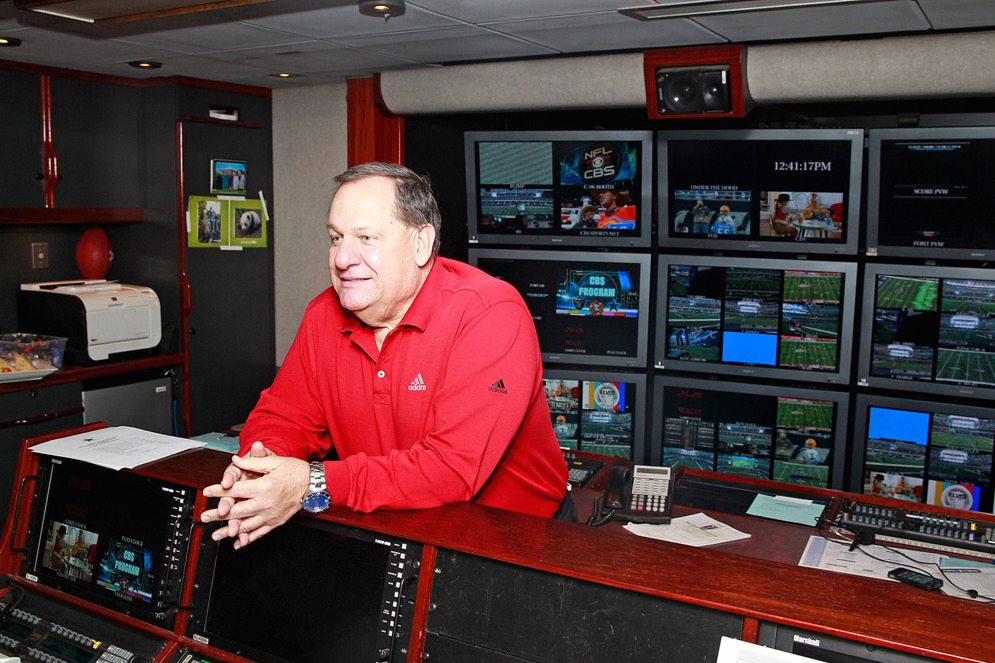
Pb football producer Lance Barrow, in the CBS Sports truck for a November 2013 Dallas Cowboys-Oakland Raiders competition. Each week, his crew produces what fans see on their televisions from multiple cameras deployed throughout the stadium. (AP Photo/James D. Smith)
In 1939, NBC was the first network to televise a pro football game, using two cameras and about eight staffers. Shortcomings in the available technology presented challenges for airing the contest between the Philadelphia Eagles and the Brooklyn Dodgers.
"It was late in October on a cloudy 24-hour interval, and when the sun crept behind the stadium there wasn't enough lite for the cameras. The picture would get darker and darker, and eventually it would be completely blank and we'd revert to a radio broadcast," play-by-play announcer Allen "Skip" Walz recounted in Football Digest.
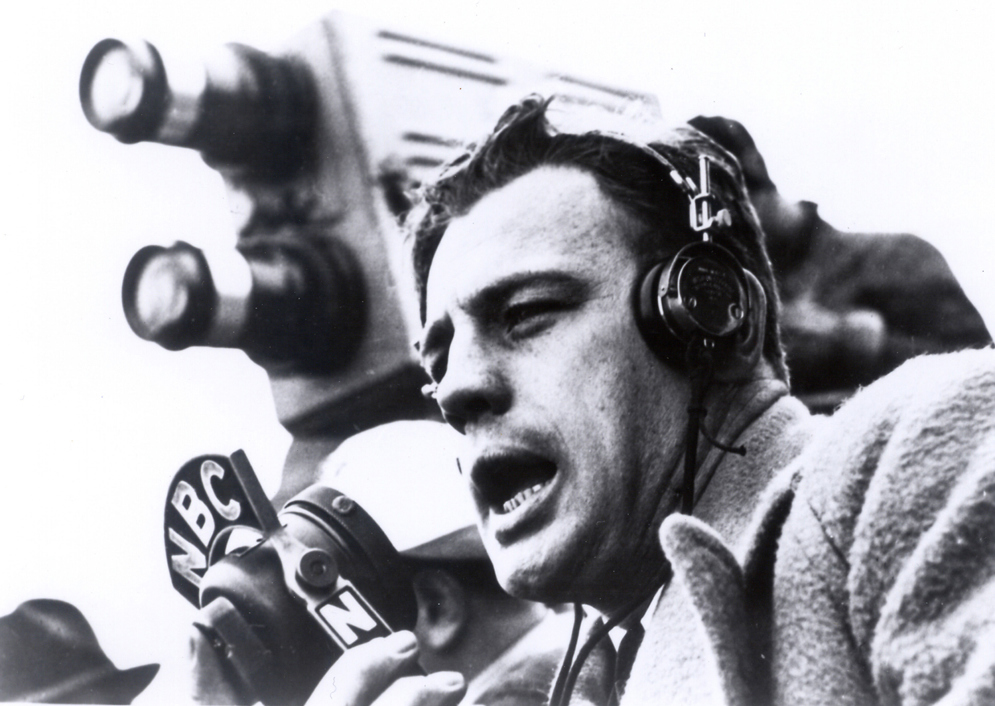
NBC play-by-play journalist Allen "Skip" Walz used two cameras for the first-ever televised NFL game, including ane that operated right over his shoulder in the stadium's mezzanine department. (Pro Football Hall of Fame)
The network broadcast the game to the roughly i,000 TV sets in New York Urban center at the time and to displays in the RCA Pavilion at the New York Earth's Fair. NBC connected to air games and — though football on TV wouldn't fully take off for a few more years — the seed was planted.
After World War II, U.Due south. consumers began buying televisions in droves, and televised NFL games became more mutual. Landmark moments in the boob tube'due south human relationship with pro football game followed, including the offset nationally televised game, "the greatest game ever played," the kickoff leaguewide TV contract, the "'Heidi' Bowl" and the births of the Super Bowl and "Monday Night Football."
Cumulatively, those events and others cemented the human relationship. The bear upon on the league has been remarkable, in both obvious and subtle ways.
Popularity, Profitability and Competitiveness
Televised games fueled the dramatic increase in the NFL's popularity and profitability. Fans soon set aside fourth dimension each calendar week to watch their favorite teams play on Sundays. Games were eventually added to other days and moved to prime number time. Goggle box elevated the Super Bowl from sporting upshot to de facto national holiday: Super Bowl XLVII, on Feb. 2, 2014, topped 112 one thousand thousand viewers in the U.Due south. alone.
Congress' 1961 decision to allow sports leagues to negotiate their ain collective telly contracts permit the NFL set up a organization to share annual television revenue equally among all teams.
Before then, big-marketplace teams like the New York Giants could earn ten times as much money every bit small-market teams like the Green Bay Packers, which gave the Giants much more greenbacks to sign the best players. But by as distributing the television revenue — in addition to sharing revenue from other sources, such as merchandising and ticket sales — the league ensures that every team has the fiscal ability to compete on and off the field.
The NFL'south revenue sharing has maintained competitiveness across all teams and has helped the league avoid fiscal disparities faced by other sports that gave teams about insurmountable advantages. Other major sports leagues accept modified their revenue sharing since 2000 to adopt systems more similar the NFL'south.
All of this contributes to greater parity among teams, competitive games and more teams in the playoff hunt each twelvemonth — improving the game for fans, players, owners and the league'southward broadcast partners.
INSTANT REPLAY
Maybe the biggest impact and symbiosis in the NFL-tv relationship involve advances in the technology that enabled the league to grow and flourish and led to its rise to prominence. Since that starting time game in 1939, broadcasters and the NFL have continued to innovate and push the limits of how television can enhance the NFL experience.
Deeper Swoop: Acquire more most the history of instant replay
Instant replay, initially used for just i play during the Army-Navy game in late 1963, soon would become ubiquitous for NFL broadcasts, especially when dull motion and freeze-frame capabilities were added and enhanced.
Replay fabricated games more entertaining. It provided a natural filler for the sport'southward many breaks in play and could be used to highlight hard hits, battles in the trenches, neat runs and catches, and other fundamental plays. Broadcasters as well used replay to improve explain the game's nuances, creating greater fan sensation, understanding and involvement.
Inevitably, instant replay became commonplace, increasing the pressure on the NFL to notice a way to use the technology to assistance game officials make the right calls.
Replay provided broadcasters and viewers with visual bear witness, in slow motility, to second-approximate the judgment calls officials fabricated on the spot at total speed. Howard Cosell, 1 of the most influential sportscasters of his day, captured the frustration while in the dissemination berth for "Mon Night Football." Later on an evidently incorrect call on a catch in the stop zone, the exasperated commentator declared to the national audience: "That's absurd; all they gotta practice is coil the tape!"
But the technology wasn't advanced plenty yet to speedily and efficiently review plays. The NFL tested replay review during the 1978 preseason and adamant that to get the calls correct, it needed at to the lowest degree 12 cameras to take enough angles on every play. But any system would rely on the circulate feed, and the networks were not yet using that many cameras.
After broadcasters began using more than cameras — and other technology improved — the NFL owners canonical instant replay reviews in 1986. They killed the system in 1992, citing delays and wrong calls, but brought it back for expert in 1999.
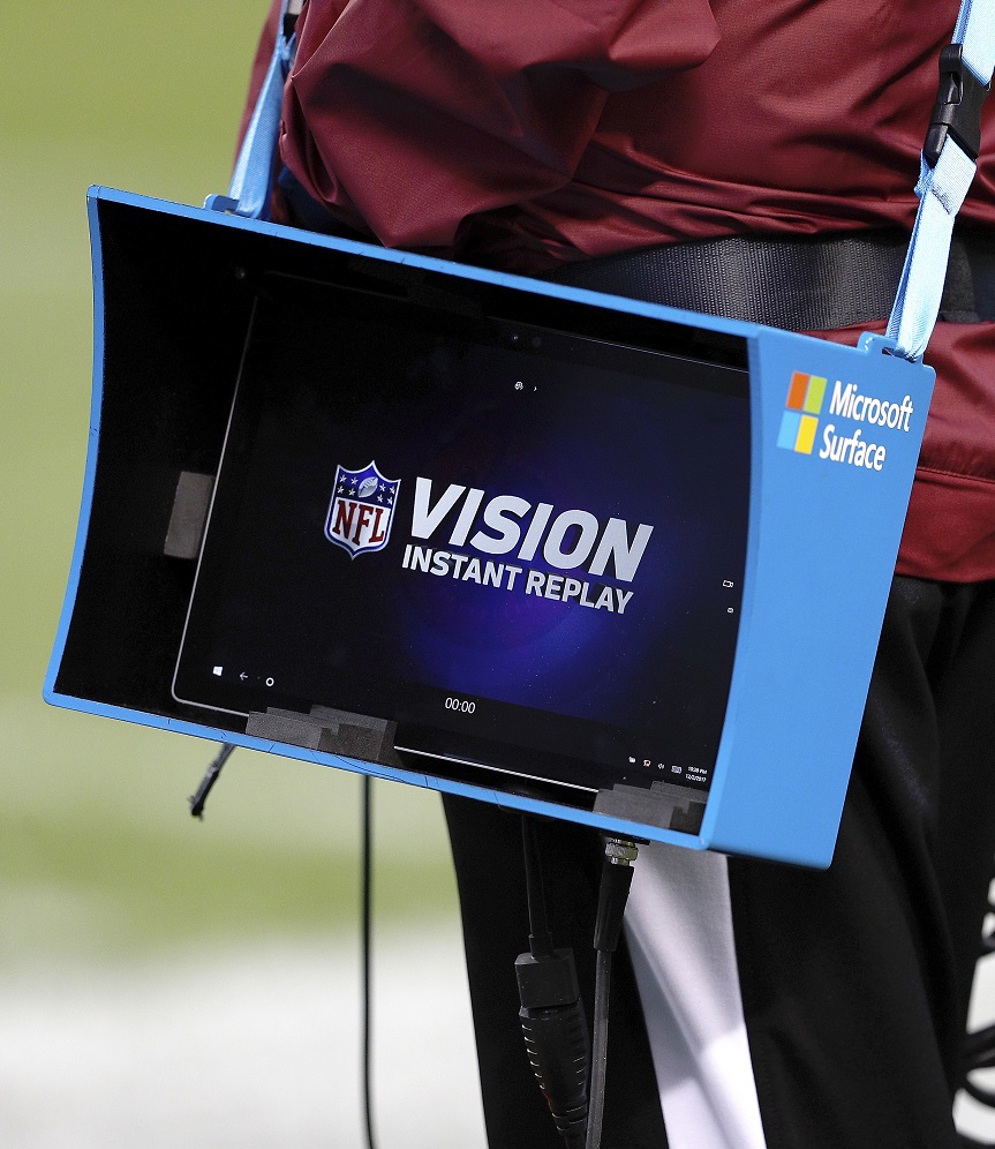
As television added more than and amend cameras, instant replay reviews improved too. Today'southward high-definition video gives officials a clearer view of what actually happened. The league's state-of-the-art NFL Vision software processes game footage and isolates plays for replay, delivering high-definition images in seconds to officials in Fine art McNally GameDay Central in New York and at the stadiums.
This is symbiosis in action. Boob tube'due south technological advances, embraced by the NFL, are used to improve the quality of the product the broadcasters are showing: the game.
TELEVISION INSPIRES INNOVATIONS
Tv set's bear upon on the game also can be realized in other ways — by teams and past the league.
It didn't take coaches long to realize the power of cameras and film every bit coaching tools. Cleveland Browns coach Paul Brown became the first coach to use pic to scout other players and coaches and to evaluate his own players.
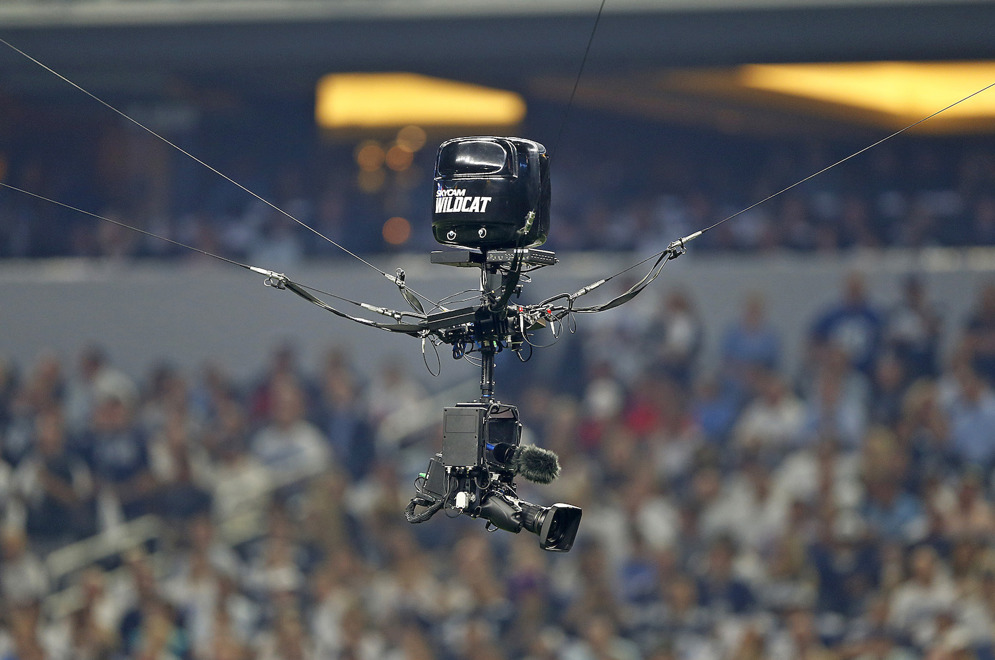
Skycam television receiver camera is suspended higher up the field during a game between the Dallas Cowboys against the New York Giants at AT&T Stadium. (James D. Smith via AP)
Today, every squad uses coaches' tapes. In addition to the network feed, the NFL captures game action from two cameras positioned high above the field in every stadium. The "All-22" angle captures every histrion on the field in a single shot, and the "End Zone" camera provides a downfield view as the play unfolds. The league now makes these resources available to fans through NFL Game Pass equally well.
The proprietary NFL Vision software as well enables the league to use game footage to help protect players and evaluate both the officials and the rules of the game.
At each game, an independently certified trainer contracted by the league uses NFL Vision to monitor the broadcast feed and place potential injuries. In plays during which a possible injury occurs, this sentry immediately notifies on-field medical staff and can even transmit a replay to a sideline monitor for the trainer or doc to view.
The Officiating Department reviews network television footage and coaches' record to evaluate officials from every angle. The software also allows GameDay Central technicians to isolate plays that merit farther review and bring them to the league's attention. They tin also store and collect important game information.
The stored footage from the television feed even contributes to the NFL's rule-making: League officials involved in the process study game film to assistance them research what to practice and rails trends, as they did in examining kickoff returns to determine the factors contributing to injuries on the play.
STADIUM EXPERIENCE
Television also improves the experience for fans attending the games. Technology has raised the quality of the calm viewing experience and so high that the NFL and its clubs ever search for means to provide a better in-stadium experience.
Oversized video scoreboards accept become the norm in all NFL stadiums. Fans rely on them for replays and closer views of game action. Home teams use them to fire upwardly the crowd and entertain the fans betwixt plays.
"Improving the game-solar day experience at our stadiums in every way possible is an important ongoing priority," Commissioner Roger Goodell told clubs in a bulletin in the NFL's 2014 Game Operations Manual. "Each of our games must be an 'event' and a 'high-quality experience.'"
Clubs keep building bigger and improve scoreboards. Cowboys Stadium (now AT&T Stadium) in Dallas opened in 2009 with the then-largest LED scoreboard — 72 feet loftier, 160 feet broad. In a stadium "arms race," the Jacksonville Jaguars unveiled two 62-feet-loftier, 362-feet-wide, high-definition LED scoreboards for the 2014 flavour.
Of form, NFL football has been very good for TV too. The games are ratings behemoths that provide networks with advertizement dollars, along with viewership that benefits the networks' promotions and not-NFL programming. Similar any proficient relationship, this one remains a two-fashion street, benefiting both the broadcasters and the game.

NFL Football Operations' mission is to found a culture of clarity, consistency and brownie in all aspects of the greatest game. Football game is an essential piece of America's fabric, uniting fans, players and communities with a simple yet powerful bond. Nosotros laurels the game'south history while continuing to innovate and preserve the sport for future generations of fans, players, coaches, teams and officials.
© 2022 National Football game League. All rights reserved. Privacy Policy NFL.com

Source: https://operations.nfl.com/gameday/technology/impact-of-television/#:~:text=Each%20game%20is%20a%20major,employees%20for%20regular%2Dseason%20contests.
Posted by: schaferjoiny1967.blogspot.com
0 Response to "How Many Video Cameras Are Used In A Football Game"
Post a Comment