

600MHz spectrum auction raised $3.47 billion
The 600MHz spectrum auction resulted in $iii.47 billion CAD with 12 companies participating, Innovation, Science and Economic Development (ISED) said on April tenth.
The auction for the coveted 600 MHz spectrum began approximately month ago on March twelfth and ended on April 4th. In that location were 112 spectrum licenses in 16 geographic locations available for telecoms to bid on.
There were 54 rounds of bidding that took place over 18 business days. Those that won spectrum licences have until April 26th to submit 20 per centum of the total final payment. The remaining 80 pct is due on May 27th.
ISED said in a news release that 104 of the 112 licences were "awarded to" nine of the 12 participants. The newly acquired spectrum will be used to "further strengthen the state's robust networks, improve wireless coverage and foster a competitive wireless market in support of lower prices."
Innovation, Science and Economic Government minister Navdeep Bains announced the section was specifically setting aside 43 percent of the spectrum (a full of 30MHz) aside for regional wireless operators and potential new entrants in order to foster competition.
In a phone interview, Bains said that it was a very good day for regional players specifically and the results "very conspicuously complemented" his proposed policy directive.
"We want to put consumers front and center when it comes to lower prices, lower prison cell phone bills and internet bills. The telecommunication proposed directive was to put consumers before whatsoever decision. This spectrum set bated, this auction clearly demonstrates there will be more competition," he said.
Montreal-based national carrier Bong did not win whatsoever licences during this sale. When asked about this, he said it was Bell's decision on how to bid for spectrum.
"I mean they can speak to what strategy they deployed only from our perspective, we were very happy with the result. Nosotros see the regional providers more than double their share of low ring spectrum and overall the regional providers take increased that spectrum across the country. That ways more than competition and where there is more competition that means better services and affordable prices for Canadians," he said.
Bell said in an email statement that it decided not to acquire whatsoever of the 600 MHz low band spectrum. Information technology said it "has spectrum assets in the low, mid and high-frequency bands in both urban and rural locations."
"Given the supply of other low-ring spectrum that Bell already possesses, 600 MHz is non required for Bell to deliver broadband 4G and 5G services," the company said.
"Bell leverages each new generation of wireless network technology to drive renewed innovation and productivity growth, and with 5G we'll take connectivity further than ever before with smart cities, continued vehicles and other revolutionary service advancements for both consumers and concern users," said Bell's chief engineering officer Stephen Howe.
"Bell looks forward to participating in upcoming federal auctions of the mid-band 3500 MHz and high ring millimetre wave spectrum that will be required to drive the Fifth Generation of wireless."
Here are conditional results of the auction:
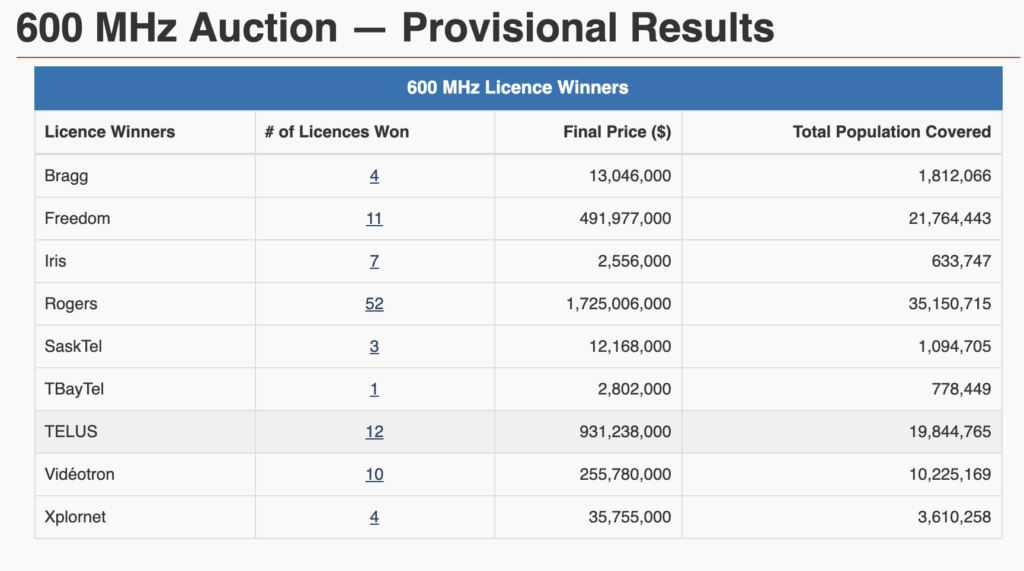
The federal government has held several auctions in the by. More recently in 2015 for the 2,500 MHz spectrum and in 2014 for the 700 MHz sale.
In 2008, the authorities set aside spectrum for the twenty MHz of Avant-garde Wireless Services sale and afterwards eight weeks and 331 rounds, the sale airtight with 292 licenses sold. The Government grossed $4,252,710,327 CAD. Globalive Communications, at the time the owner of Wind Mobile, came out as a strong winner.
This time around, the 12 players have gotten a agree of the 600 MHz spectrum licence, which operators are hoping to use in the rollout of their upcoming 5G networks.
5G operates over traditional and new cell radio frequency bands that include the depression- (sub-1GHz such every bit 700MHz), mid- (one.6GHz, around 3.5-3.8GHz), and millimetre-moving ridge (mmWave, such as 28GHz) ranges.
This auction will offering operators a spectrum that is depression-frequency and is able to penetrate through buildings and provide long altitude coverage.
Carriers react to the results
Toronto-based national carrier Rogers said in a statement that it was pleased with the results, noting that its investment of $one.7 billion will "enable 5G deployment in urban, suburban and rural communities."
"We are proud to brand leading and meaningful investments to build the 5G ecosystem in Canada and to aid drive our country's global competitive reward," Rogers' CEO Joe Natale said. "This 5G spectrum is precious and scarce resources that will do good Canadians and Canadian businesses across the country."
Iristel, parent visitor of northern regional carrier Ice Wireless and MVNO Sugar Mobile, said in a release that it was exciting "on many levels."
Iristel and Ice Wireless' CEO Samer Bishay said from a engineering perspective this spectrum "works exceptionally well in remote areas by roofing longer distances."
"We'll exist able to raise services in the Territories. Second, we tin can now offer the benefits of real contest to consumers and businesses in Newfoundland and Labrador and give them relief from the Big Iii wireless oligarchs. This is an important step toward more than choices, lower prices and h8igher quality cell telephone services for Newfoundlanders, Labradorians and those in remote areas of Canada's north, including Quebec," he said.
Regional carrier Shaw said it intends to use the spectrum to "amend electric current LTE service and lay the foundation for 5G" services.
"Nosotros have made significant investments to better the wireless experience for Canadians, condign a true alternative to the incumbents, with a differentiated value suggestion. The addition of this 600 MHz low band spectrum will not just vastly meliorate our current LTE service but volition as well serve as a foundational element of our 5G strategy providing innovative and affordable wireless services," Shaw'southward CEO Brad Shaw said in a statement.
Vancouver-based national carrier Telus said the results of the sale will assistance deliver better mobile broadband connectivity, especially as the industry transitions from 4G to 5G.
"The conquering and deployment of this spectrum is critical to the advocacy of our national 5G growth strategy and to the global-leading network quality, speed and coverage we provide to Canadians," Telus' CEO Darren Entwistle said. "As the need for wireless data continues to abound, the acquisition of 600 MHz spectrum will enable TELUS to deliver enhanced urban and rural connectivity to our customers on Canada's fastest and most reliable network."
While the carrier secured 12 licences and invested $931 million, Entwistle said the inflated price per spectrum block was challenging.
"The average price per MHz-popular paid by the national carriers in the open up sale was $1.08 higher on average than what was paid by those in the set bated, which equates to an gauge subsidy of $i.1 billion past Canadian taxpayers. Disappointingly, the design of the 600 MHz auction resulted in the highest prices paid for 600 MHz spectrum in the world.
"In the U.S., for case, providers paid on average $0.93 per MHz-popular. By dissimilarity, Canadian national carriers paid on boilerplate roughly two times as much, at $1.89 MHz-popular," he said.

Source: https://mobilesyrup.com/2019/04/10/600-mhz-raised-3-47-billion/
Posted by: schaferjoiny1967.blogspot.com
0 Response to "600MHz spectrum auction raised $3.47 billion"
Post a Comment